Core stability activities
To move well, our bodies need to be steady and strong. This means we need to keep our joints stable. If our core isn’t strong, we won't be able to balance the muscles around our stomach, hips and shoulders.
How to engage stomach muscles
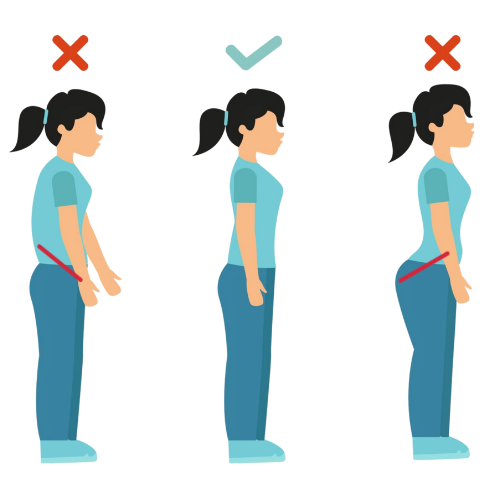
It's important that your child uses their stomach muscles when working on the activities on this page. Encourage them to pull their ribs down to their pelvis, and not to stick their chest out. 
Core exercises
-
Ask your child to make a pose that has a certain number of body parts touching the floor at one time. Can they hold the pose for 10 seconds? How many different poses can they make using the same number of body parts?
-
Ask your child to lie on their back with their hands on their head. Ask them to try stand up whilst keeping both hands on their head.


-
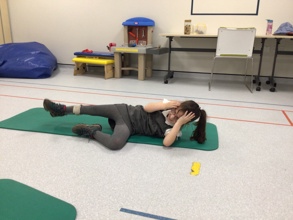
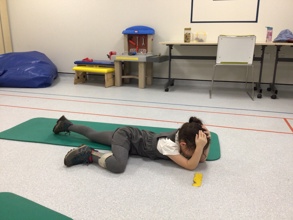
Ask your child to lie on their side with their bottom leg bent and top leg straight. They may need to place their hand in front for stability to begin with.
You will need to check that your child keeps their back still and that they don't roll forwards or backwards.
Whilst keeping their leg straight, can they draw shapes with their foot? Can they write their name with their foot?
-
Place something soft and flat on their head, such as a bean bag. Ask them to try walking around whilst keeping it on their head.
-
Ask your child to lie on their backs with their knees bent and their feet flat on the floor. Can they lift their bottom off the floor whilst straightening one leg in the air?
-
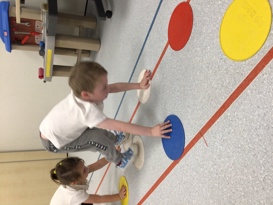
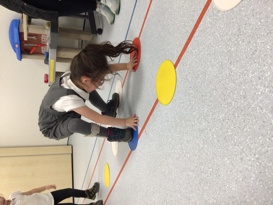
Ask your child to stand up and place their hands near their feet on the floor. Whilst keeping their legs straight, see how far they can walk their hands out in front of them. The aim is to not let their stomach touch the floor.
Can they then walk the hands back in towards their feet?

-
Ask your child to lie on their back with their hips and knees at 90 degrees, and their arms outstretched towards the sky.
Can they move one arm backwards towards the floor and then return it to the starting position?
Can they do the same with one leg?
Can they do opposite arms and legs at the same time?
Remember, they need to try and keep their ribs tucked down, close to their pelvis, rather than opening their chest.
-
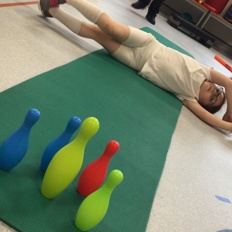
Ask your child to lie on their back with their arms and legs stretched out straight. Can they keep a straight shape whilst rolling towards skittles? Can they knock the skittles down?

-
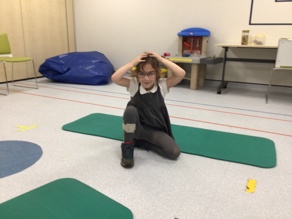
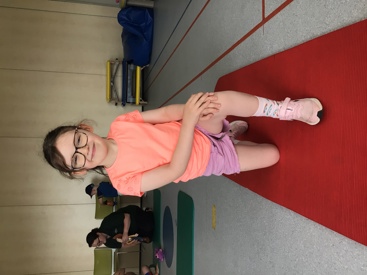
Ask your child to kneel on the floor in a high position without their bottom touching their feet. Encourage them to bring 1 leg forward in front of them with their knee bent, to a half-kneel position.
Once in position, play a game of catch by throwing a ball to them back and forth, facing straight on. Then play a game, throwing the ball from the side at a different angle.
Complete 10 throws and change legs.

-
Starting on all fours with knees and palms touching the floor, ask your child to raise one arm, stretching it forward, and stretch out the opposite leg behind them.
Encourage your child to hold this position for 5 seconds, before relaxing and then doing the same activity with the opposite arm/leg.
To make the activity more challenging, your child could hold the position for 10 seconds, or longer, based on their strength.
-
Ask your child to sit on their bottom with their knees bent and their palms face down by their sides.
Ask them to lift their bottom off the floor and use their hands and feet to take their weight. Encourage them to move forwards, backwards and sideways across the floor.
-
With your child lying down on their back, ask them to curl their head forwards, and bring their knees up to their chest, with their arms crossed in front of them.
Ask them to hold the pose for 5 seconds, and work their way up to 20 seconds as their strength improves. Once they feel confident they can try the jellybean activity by rocking their body from side to side in this pose.
Breaking the egg
Ask your child to get into 'the egg' position again. You should try and pull them apart by gently pressing on their forehand and above their knees.
-
Ask your child to lie on their stomach with their arms in front of them. At the same time they should raise their head, arms and legs off the ground. Their legs should be kept straight. Encourage your child by saying 'you're flying like superman'.
Start with them holding this position for 5 seconds. Slowly they can work their way up to 20 seconds as their strength increases.
-
Ask your child to lie on their stomach and prop themselves up on their forearms. Place a football between their hands. Ask your child to use both hands to roll the ball away from their body, whilst keeping their hands and arms in contact with the ball. Then roll it back to the starting point. Repeat this 5 times.
Then ask your child to repeat the activity but only using their right hand. Then they can repeat the activity only using their left hand.
Slowly increase the number of repetitions as your child's stamina increases.
-
Ask your child to lie on their back and lift their head so their chin touches their chest. Ask them to hold this for 3 seconds and slowly bring their head back to the floor. Slowly increase this to 5 repetitions as their strength increases.
-
Ask your child to lie on their back with their hips and knees bent at right angles. Ask them to move their legs as if pedalling an imaginary bike. Count how many times they can do this before needing to take a break. Record how many times they can do this and encourage them to increase either the time of the number of cycles.
-
Wall push ups - Ask your child to place their body at a 45 degree angle to the wall. Shoulders should be directly in front of elbows and wrists. Elbows should be straight.
Ask your child to bend at the elbows, keeping their back straight to complete a push up. Aim for 10 wall push ups.
Table push ups - Ask your child to stand behind a table. They should place their arms straight out in front of them, with flat palms and outstretched fingers on the table. Keeping their arms straight, they should rock forwards and backwards and from side to side. Then they can bend their elbows to do a push up.
Floor push ups - When your child can do wall push ups they can move onto floor push ups. It is easier to do kneeling press ups to start. Then move onto straight leg press ups when they have built up their strength. Help your child to do push ups with straight arms and keeping their trunk straight.
-
Ask your child to hold their arms out to the side. They should make 10 small circles from the shoulder in a forward direction. Then make 10 small circles in a backward direction.
-
Ask your child to position themselves on their hand and knees. Take hold of your child's thighs above the knees. Encourage your child to walk on their hands. Their hands should face forwards and they should walk with straight arms.
If your child finds this difficult, try supporting them near their hip joints. Then slowly progress downwards to above the knee.